 Official Government Website
Author: Megan O'Rourke
LCSC grad takes over Collision Repair Technology program
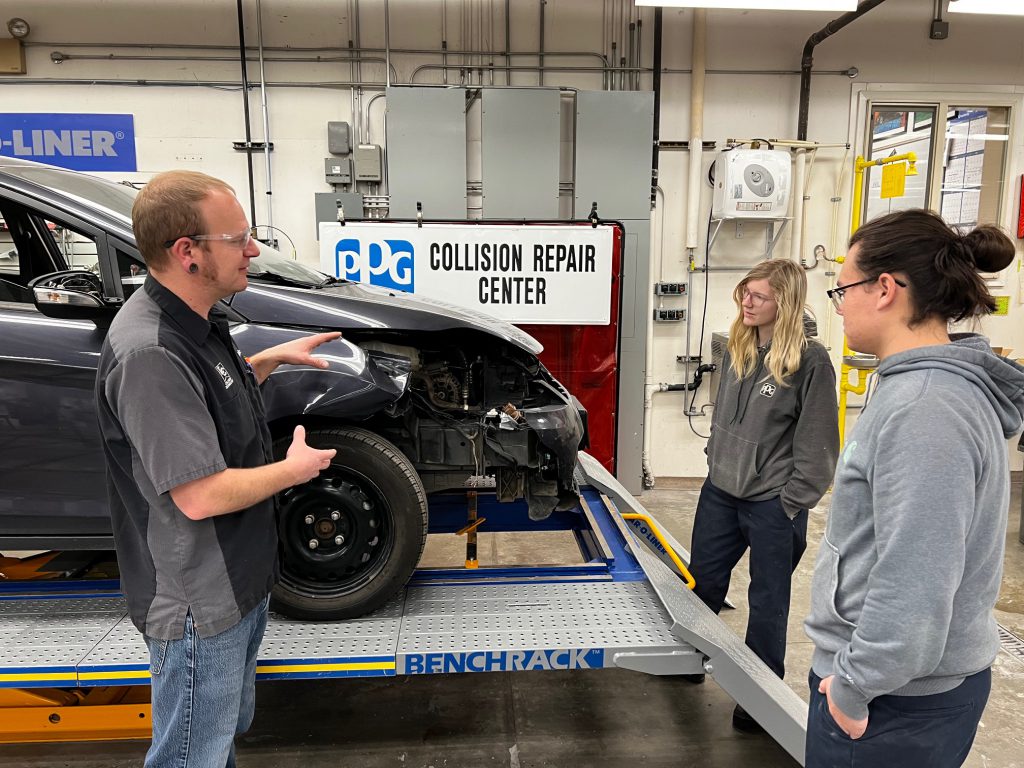
Growing up in the unincorporated town of Laclede, Idaho, Luke Thomas didn’t know what he wanted to do after high school—but he did know he loved working on cars.
“We had a neighbor who worked on cars, and he helped me restore my first vehicle,” said Thomas.
From then on, Thomas was hooked. A family friend who taught at Lewis-Clark State College (LCSC) recommended its two-year Collision Repair Technology program. The program’s reputation, hands-on application, small class size, and one-on-one time with the instructor all appealed to Thomas, who graduated with an Associate of Applied Science in 2008.
After graduation, Thomas’ career was humming along. He had his own repair shop and worked on custom restorations, but he wanted to explore a different facet of the industry. Around that time, Thomas’ professor, Clarence Griffin, decided to transition to teaching part-time, so Thomas saw an opportunity to teach in the same program from which he graduated.
“I was ready for a change and the opportunity to teach the collision program arose at the right time,” said Thomas. “It sounded like a fun way to change things up and help make a difference in the industry.”
During his first three years teaching, Thomas was grateful to be teaching alongside Griffin. And for the most part, Thomas kept the program the same as when he completed it. During the first year, core instruction is provided, and during the second year, students receive in-depth instruction in more complex systems and hands-on training in mock and customer projects.
“Because it’s a two-year program, students can go beyond just learning metal straightening or crash repairs,” said Thomas. “That means we can focus on more advanced skills, and they can get exposure to more facets of the collision repair industry. They’re qualified for a broad spectrum of industry segments by the end of the program, including some outside the collision field, like aviation refinishing, boat manufacturing refinishing, heavy trucks collision repair, custom cars, and hot rods.”
Luke Thomas
A major component of the program is completing an eight-week internship with a local shop. Many students have jobs lined up after graduation at the shop where they completed their internship, which many keep until they decide to move on. The internship allows employers to tap into a talent pipeline to fill their needed positions, which Thomas says translates into more support for the program. Body shop owners have donated vehicles, parts, and uniforms or provided scholarships for the students, and vendors will come in for demonstrations or product training.
Six years later, Thomas has found what he was looking for as a career technical educator. Teaching gave him the freedom to continue running his repair shop and custom restoration business while having more time to pursue other interests. It’s also given him a more holistic perspective of the industry he loves, deepening his appreciation for it.
Above all, Thomas says teaching has allowed him to share his passion with others. “I like seeing someone make something of themselves,” said Thomas. “It takes a lot of work to complete the two-year program, and it’s very rewarding to see a student who completed the program working in the industry and enjoying it.”
HVAC program provides seamless transition from secondary to postsecondary
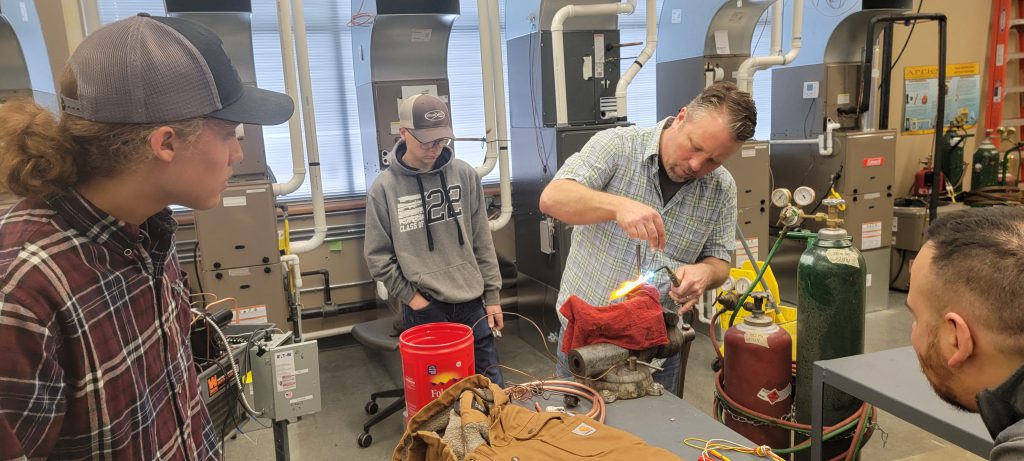
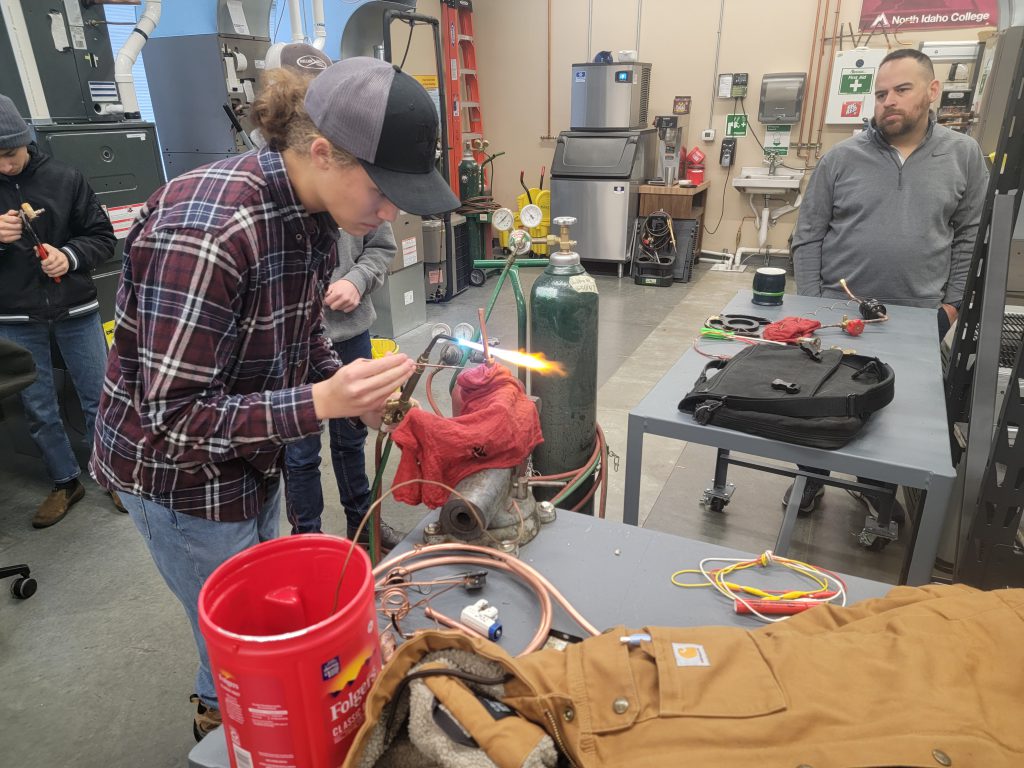
The week before the fall 2017 semester began, Sean Sater received a call from the Trades and Industry Division Chair at North Idaho College (NIC), Doug Anderson. Anderson wondered if Sater would be willing to teach the heating, ventilation, and air conditioning technician (HVAC) class; if Sater said no, the program would be shut down.
Fortunately, Sater, who has 22 years of experience in the field, knew firsthand how much the Coeur d’Alene-Spokane area needed well-trained HVAC technicians. He’d also considered cutting back his hours at HollisterStier, where he worked as a consultant, so he agreed.
“I thought it was a great way to pay it forward and help the next generation change their stars,” said Sater.
Though his first year was a baptism by fire of sorts, Sater enjoyed teaching. So when Anderson, who also served on the board of Kootenai Technical Education Campus (KTEC), asked if Sater would be interested in teaching HVAC at the secondary level the following year, he again agreed.
“I was head over heels to get a hold of them early and get them trained up right,” said Sater. “When we first sat down, we didn’t want the HVAC program to be a huge expense, so we decided it would be best to let the KTEC students use the NIC lab. It’s within walking distance, and we didn’t have to bring in more equipment, which helped us strengthen the partnership between the secondary and postsecondary programs. It was a win-win-win for the students, the schools, and the taxpayers.”
Next, Sater had to strike a balance between offering enough dual credit to make the HVAC pathway appealing to secondary students but not reducing the course load so much that students wouldn’t be considered full-time students and not qualify for financial aid once they transferred to NIC. Sater settled on offering the three-credit HVAC 165 course for his KTEC students, making it easy for them to transition to the second semester’s coursework at NIC.
Sater’s unique position at KTEC and NIC means he can ensure his students have a seamless path from secondary to postsecondary to career. And because there is such a demand for HVAC technicians, employers are eager to speak to his classes and offer opportunities for his students to job shadow or do ride-alongs with their employees.
“It gives them a chance to see if an employer’s culture fits what they’re looking for,” said Sater. “They can talk with industry professionals and see how they operate, keep their vans, and figure out if it would be a good fit—and they get paid to do so.”
Sean Sater
These interactions with employers mean most postsecondary students in their second and final semester know where they want to work and have a job lined up after graduation. The jobs Saters’ students walk into don’t exactly pay minimum wage, either.
“They’re paying $9,000 for books and tuition and can be making $52,000 a year to start, without the baggage of student debt,” said Sater. “That’s a pretty solid return on investment.”
At the end of the day, Sater loves knowing he’s setting future professionals up for success while helping to meet industry needs.
“I love the feeling of getting through to someone,” said Sater. “They might ride the struggle bus for a while, but when things come together, they learn it and burn it into their memory. It’s priceless to see the light come on.”
Student Leadership Conferences will be held in person
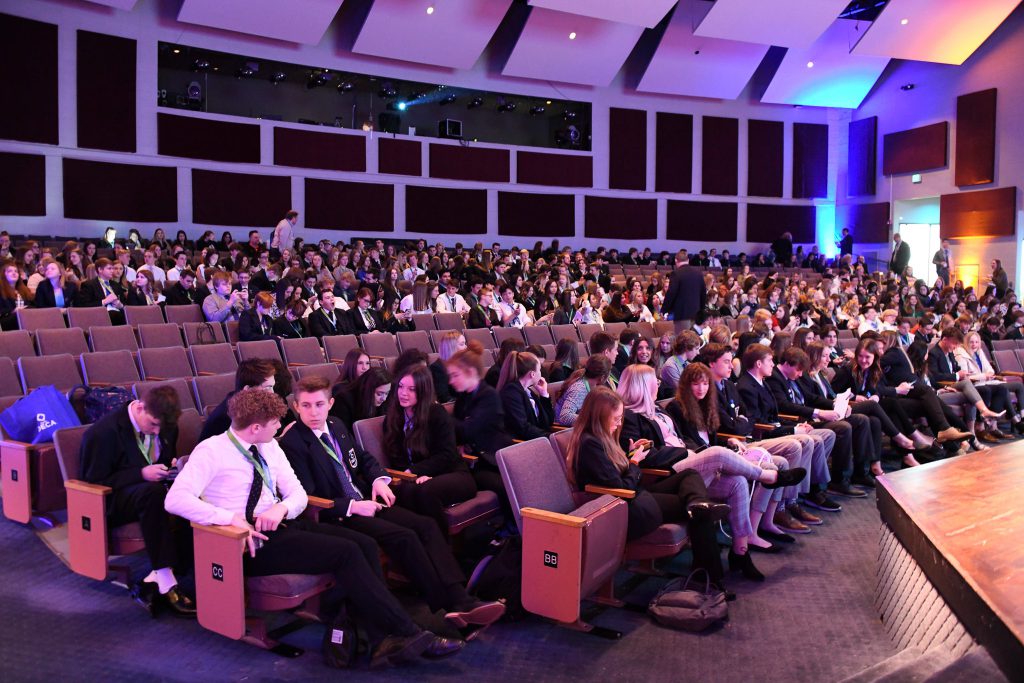

The Idaho Division of Career Technical Education (IDCTE) is continuing its preparation to hold all seven spring Student Leadership Conferences (SLCs) in person in 2022.
IDCTE considers all attendees’ health, safety, and well-being to be of the utmost importance. Further, we’re committed to providing a safe, productive, and welcoming environment at each event. Therefore, we’ll follow the recommendations of national, state, and local health agencies and the policies of the venues hosting our events. (A complete list of events and locations is available on our website.) Because of the rapidly changing nature of the pandemic, we reserve the right to modify policies around masking and social distancing at any time.
We’ll continue to monitor and update safety precautions as the situation changes and will work diligently to communicate any changes as they occur.
SkillsUSA Idaho earns Gold level recognition through the State Standards of Excellence Program for two consecutive years
For the second year in a row, the SkillsUSA Idaho association achieved the Gold level of SkillsUSA’s State Standards of Excellence Program.
SkillsUSA is a career technical student organization (CTSO) dedicated to improving the quality of America’s future skilled workforce through developing personal, workplace, and technical skills grounded in academics. Students participate in activities and competitive events designed to prepare them for leadership in the world of work. Membership is organized into chapters at participating high schools and postsecondary institutions; these chapters are overseen by the state association, which the State Standards of Excellence program is designed to recognize.
Now in its fifth year, the program is designed to ensure state associations have in place policies, procedures and structures that deliver a high level of service to members. This non-competitive program serves as a system to allow states to benchmark their performance and determine improvements to become the very best organization for their members.
“Achieving Gold level for two years in a row is a sign that SkillsUSA Idaho is determined not just to get back to ‘normal,’ but set an example for our members that we will emerge from the pandemic as leaders on a national level,” said SkillsUSA Idaho State Director Chet Andes.
Andrew Armstrong, CTSO manager for SkillsUSA Idaho, echoes Andes’ sentiment.
“Winning this award for two years gives me great pride in the direction of SkillsUSA Idaho. This award shows that we are committed to our membership and are fully committed and prepared to serve our chapters,” said Armstrong. “I hope this opportunity challenges our members to build strong chapters that are as excited as we are to show how amazing our Idaho members are at the national level.”
Nationally, 38 states participate in SkillsUSA. The following state associations were recognized for achieving the Bronze level of establishing a baseline for a healthy association: Arkansas, Colorado, Iowa, Nebraska, New Hampshire, North Dakota and South Dakota.
The following states moved to the next level by being recognized for achieving Silver, ensuring the sustainability of healthy association: Alabama High School, Indiana, Kentucky, Louisiana College/Postsecondary, New York High School, Utah, West Virginia and Wyoming.
The following states reached the pinnacle of achievement by completing the Gold level requirements, ensuring the continued growth of the association: Arizona, California, Florida, Georgia College/Postsecondary, Georgia High School, Idaho, Illinois, Kansas, Maine, Massachusetts, Nevada, New Jersey, New Mexico, North Carolina, Ohio, Oregon, Pennsylvania, Rhode Island, South Carolina, Texas College/Postsecondary, Texas High School, Virginia and Washington High School.
For more information about SkillsUSA, visit skillsusaidaho.com or skillsusa.org.
Idaho Division of Career Technical Education awards $3.5 million in “Building Idaho’s Future” grants to secondary and postsecondary CTE programs

The Idaho Division of Career Technical Education (IDCTE) has awarded $3.5 million in grants to expand and modernize Idaho’s secondary and postsecondary career technical education (CTE) programs to meet Idaho’s growing need for a skilled workforce. The grants were awarded to all six technical colleges and a mix of rural and urban districts statewide.
The one-time funds were made possible by the “Building Idaho’s Future” initiative, Governor Brad Little’s plan to use Idaho’s record budget surplus to provide Idahoans historic tax relief and make strategic investments in transportation, education, broadband, water, capital construction, and other critical areas.
“By investing in career technical education, we are investing in our workforce and Idaho businesses. My ‘Building Idaho’s Future’ plan is all about strengthening our state for today and the next generation of Idahoans,” said Governor Little.
CTE programs that provide state-of-the-art, hands-on training for high-skill, in-demand careers have increased in popularity.
“The intentional alignment between our secondary and postsecondary CTE programs provides for a seamless, more efficient, and cost-effective mode of continuing education. That means less time—and money—to acquire the necessary training to obtain in-demand jobs,” said Clay Long, state administrator for IDCTE. “Idaho’s employers have a hand in developing a talent pipeline catered to their needs, and our Governor and legislators can see that CTE programs help to fill the skills gap and keep Idaho competitive.”
To be eligible for funds, programs were prioritized based on alignment with regional workforce needs, demand for occupation, number of job openings, and projected growth rate.
“We wanted to make sure we were investing in occupations that are growing in demand, both to ensure employers have a skilled workforce and students can find jobs in their area of study upon completing their programs,” said Long.
In addition to granting funds for secondary and postsecondary programs, Building Idaho’s Future also provided $3 million to the College of Eastern Idaho’s FutureTech building, an 88,000 square-foot, state-of-the-art facility designed to house labs and classrooms to accommodate students in energy, environmental, and technology programs. It also provided $1.25 million for Workforce Training Centers (WTCs) to develop and deliver content, including $750,000 for training programs specific to the food processing and manufacturing industry. WTCs, which are located at Idaho’s six technical colleges, develop programs to help train or retrain employees to keep up with the needs of their employers and fill hard-to-fill positions.
“We appreciate Governor Little’s recognition of the shared level of importance of ensuring students enrolled in secondary and postsecondary programs and Idahoans already in the workforce have access to the technology, training, and equipment they need to be ready for their careers,” said Long. “It will be exciting to see how this investment in our students and workforce will help our state in the months and years to come.”
Idaho teachers, students, earn accolades at the HOSA International Leadership Conference

Four teachers and 10 students from Idaho earned accolades at the virtual HOSA International Leadership Conference held June 23-26, 2021. The conference featured general sessions, workshops, and competitive events that focused on leadership, professional, and technical skills.
Highlights included inducting Meridian Medical Arts Charter School teacher Carie Staub into the HOSA Hall of Fame. Staub, a licensed athletic trainer, teaches health sciences and sports medicine, serves as a HOSA advisor, and sits on the HOSA board of directors and the planning committee for the state leadership conference.
The HOSA Hall of Fame was created to honor and recognize individuals and companies who have rendered outstanding service to HOSA, health and biomedical science education, and the health industry. Each year, one chartered association advisor, one local advisor, one member, one alumnus and one partner is inducted into the Hall of Fame; Staub was inducted as a local advisor.
“Carie was committed to ensuring this year’s virtual State Leadership and International Leadership conferences looked and felt as normal as possible for all students during an unpredictable year,” said Stephanie Mai, Idaho HOSA state advisor. “She continually dedicates her free time to grow and develop opportunities for her own students, as well as all HOSA members. Idaho HOSA would not be the same without her profound knowledge, spirit and commitment.”
Three other Idaho teachers received recognition during the June 26 awards session:
- Blake Gaudet, Outstanding Local Advisor (Secondary), Meridian Medical Arts Charter High School, Meridian
- Rene Rambur, Outstanding Local Advisor (Postsecondary), College of Southern Idaho, Twin Falls
- Olivia Swainston, Outstanding HOSA Leader, Idaho State University, Pocatello
Idaho students also earned awards and honors at the international conference:
Postsecondary/collegiate division:
- Soraya Berry, 2nd place, Job Seeking Skills, College of Southern Idaho, Twin Falls
- Kassandra Klimes, 5th place, Dental Science, College of Southern Idaho, Twin Falls
Secondary division:
- Madison Boring, Silver Service Award (175-249.9 service hours), Canyon Ridge High School, Twin Falls
- Xavier Christy, $1,000 scholarship recipient from the Association for Career and Technical Education Health Science Education Division, Meridian Medical Arts Charter High School, Meridian
- Kyra Deville, Bronze Service Award (100-174.9 service hours), Canyon Ridge High School, Twin Falls
- Angel Dominguez, 1st place, Job Seeking Skills, Grangeville Chapter
- Hailie Goldthorpe, Silver Service Award, Mountain Home High School, Mountain Home
- Wency Suo and Karoline Yang, 6th place, Health Career Display, Boise High School, Boise
- Cynthia Zepeda, Bronze Service Award, Canyon Ridge High School, Twin Falls
“We’re really proud of our students and how well they adapted to the virtual events and competitions,” said Jessie Kellogg, Idaho HOSA manager. “We know how hard they had to work to overcome the obstacles of the past year.”
Idaho CTE students bring home 8 medals from national competition

Forty high school and college-level career and technical education (CTE) students from across Idaho qualified for the 2021 SkillsUSA National Championships. Of the qualifiers, 17 students finished in the top nine for their competition, and eight students placed in the top three.
“This year’s accomplishments prove that even in a virtual year, our members are empowered to succeed, no matter the format or obstacles placed in front of them,” said Daniel Kelly, state manager for SkillsUSA Idaho.
The 57th annual competition, held virtually June 21-24, showcased CTE students from across the country competing in trade, technical and leadership events. During the competition, students worked against the clock and each other, proving their expertise in occupations such as electronics, computer-aided drafting, precision machining, medical assisting and culinary arts using testing competencies set by industry.
All contests were run by SkillsUSA, a nonprofit partnership of education and industry founded in 1965 to strengthen America’s skilled workforce. Driven by employer demand, SkillsUSA helps students develop necessary personal, workplace, and technical skills grounded in academics. Statewide, SkillsUSA Idaho has 898 student members representing 25 chapters. Members have consistently demonstrated their expertise and professionalism while participating throughout the year in various leadership and competitive conferences.
“I’m really proud of how our advisors and students stuck with it through a challenging year while continuing Idaho’s legacy of leadership at the national level,” said Chet Andes, state director for SkillsUSA Idaho.
In addition to receiving gold, silver and bronze medals, many top students also received prizes such as tools and scholarships to further their careers and education.
The following students finished the 2021 state conference with outstanding accomplishments:
Gold medals:
- Ashleigh Anderson, Automotive Refinishing Technology, North Idaho College, Coeur d’Alene
- Carter Meyers, Automotive Service Technology, Idaho Falls High School, Idaho Falls
- Christian Soulsby, Internetworking, Dennis Technical Education Center, Boise
Silver medal:
- Brett Williams, Diesel Equipment Technology, Cassia Regional Technical Center, Burley
Bronze medals:
- Logan Farley, Collision Repair Technology, North Idaho College, Coeur d’Alene
- Maxwell Fisher, Information Technology Services, Dennis Technical Education Center, Boise
- Spencer McConnell and Gavin Prasch, Cyber Security, Dennis Technical Education Center, Boise
Finalists:
- Alyssa Doering, T-Shirt Design, Meridian Technical Charter High School, Meridian
- Brooklyn Grant, Computer Programming, Meridian Technical Charter High School, Meridian
- Richard Huber, Automotive Refinishing Technology, Kootenai Technical Education Campus, Rathdrum
- Audrey Norris and Mason Tolley, Interactive Application and Video Game Design, Meridian Technical Charter High School, Meridian
- Hayden Reed, Telecommunications Cabling, Dennis Technical Education Center, Boise
- Ransom Robertson, Collision Repair Technology, Kootenai Technical Education Campus, Rathdrum
- John Saccomando, Technical Computer Applications, Meridian Technical Charter High School, Meridian
- Sean Varie, Electronics Technology, Meridian Technical Charter High School, Meridian
Idaho achieves the Gold level of SkillsUSA’s State Standards of Excellence program
Idaho is one of 23 state associations to achieve the Gold level of SkillsUSA’s State Standards of Excellence program for 2020.
SkillsUSA is a career technical student organization (CTSO) dedicated to improving the quality of America’s future skilled workforce through the development of personal, workplace, and technical skills grounded in academics. Students participate in activities and competitive events designed to prepare them for leadership in the world of work. Membership is organized into chapters at participating high schools and postsecondary institutions; these chapters are overseen by the state association, for which the State Standards of Excellence program is designed.
Now in its fourth year, this non-competitive program encourages state associations to meet organizational, governance, and fiscal responsibility standards, thus benchmarking their performance and determining improvements to serve their members best. Though the SkillsUSA Idaho state association earned a Silver level in 2019, this is the first time the Idaho state association has achieved the Gold level. The achievement is especially notable given the challenges created by the coronavirus pandemic during the 2019-2020 school year, including canceling the State Leadership and Skills Conference (SLSC) in 2020, planning a virtual SCLC in 2021, and transitioning competitive events to a virtual environment.
“Earning the Gold Standard of Excellence really shows the commitment of everyone involved in SkillsUSA across the state of Idaho and provides a very bright spot during a difficult year,” said Chet Andes, SkillsUSA Idaho state association director. “It’s a sign of good things to come, and we’ll emerge stronger as an organization and state.”
Daniel Kelly, CTSO manager for SkillsUSA Idaho, echos Andes’ sentiment.
“To me, this shows that SkillsUSA Idaho’s members are truly Champions at Work. Even in a virtual year, we’re able to attain greater goals and challenges constantly,” said Kelly. “Achieving the Gold level Standards of Excellence for the first time is testament to the strength of our association, our teachers, and our students, who are empowered to succeed every day.” For more information about SkillsUSA, visit skillsusaidaho.com or skillsusa.org.
CTE helps horticulture student’s passion and career bloom
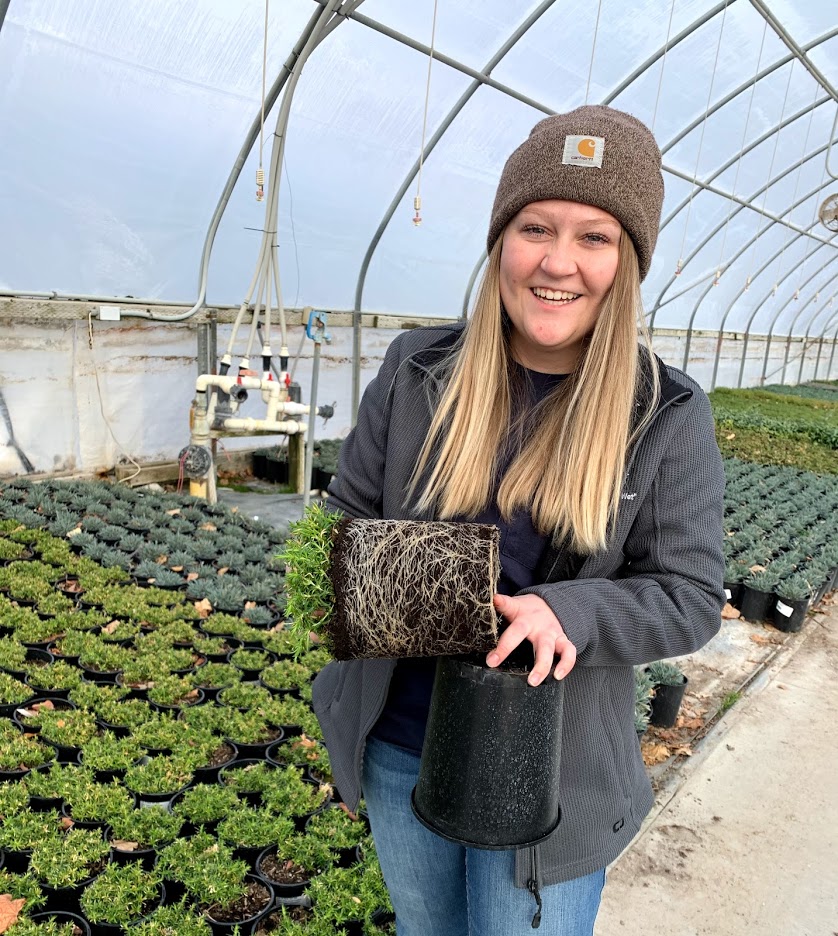
“I love my job. I love getting to work with plants and watch them change throughout the year.”
Ellie Garrard
Ellie Garrard didn’t set out to be a horticulturist. When she graduated from Burley High School in 2017, she chose to go to the College of Southern Idaho (CSI) because it was close to home. She was introduced to the idea of horticulture from one of the leaders of her youth group at church who had a degree in horticulture, and Garrard was fascinated with the massive gardens she kept.
“I liked that she could make her own schedule, and she really inspired me to work with plants,” said Garrard.
But it was not the image of perfect gardens that made Garrard decide to pursue a degree in horticulture herself—it was the idea of climbing trees with a chainsaw.
“I’m kind of a small person; I’m just five feet tall,” said Garrard. “But the thought of someone like me being able to climb a tree with a chainsaw like any big, burly man kind of excited me.”
Garrard soon fell in love with the different ways to climb trees. Her professor, Chance Munns, taught her how to tie different knots and use lanyards to climb trees. For one class, Garrard got to climb one of the biggest cottonwood trees on campus; she was one of the only students to reach the top.
“I was so excited! It made me want to buy climbing equipment and a chainsaw,” she said.
To make sure horticulture was a good fit, Garrard interned for a tree pruning service one summer. She learned how to completely take down trees, install sprinkler systems and lay sod.
“I loved it, but it was really hard on my body,” she said. “In the process, I discovered I was really good at pruning fruit trees, though.”
While Garrard pruned fruit trees for friends and neighbors while she was going to CSI, she had no idea it would eventually play a large role in her career. When Garrard graduated from CSI with an Associate of Applied Science degree in horticulture in the spring of 2019, she moved home for a few months to plot out her next move. Her mother ran into an acquaintance from church who owned Teton Trees. They had an opening for a pesticide applicator that had gone unfilled for months.
“As it turned out, pesticide application was the only class I wasn’t able to take at CSI,” said Garrard. “But the position had been open for several months, and they said they were willing to train me, so I took it.”
At first, Garrard was hesitant because the pest control side of horticulture was so new to her.
“I also didn’t know how much I’d remember from school. I didn’t know the names of all the weeds and leaves or how to determine what kind of bug was causing damage, but I kept at it,” Garrard said.
Her hard work paid off, and Garrard was soon promoted to assistant grower of plant health.
“When I realized I did have the training and knowledge that were needed in a plant health position, those skills—like pruning—really came back,” she said.
In fact, Garrard wrote Teton Trees’ employee pruning guide to ensure all pruning crews were following the same standards companywide.
“At our smaller location, we only have one or two pruning crews, but in Paul, there are three or four pruning crews, and many of them only speak Spanish,” Garrard said. “I wrote the guide and worked with some translators to ensure all our employees were following the same standards.”
Like the plants she tends, Garrard is thriving in her new role.
“In horticulture, there’s a lot of on-the-job training, and we learn a lot from consultants,” said Brett Bingham, Teton Trees’ general production manager and Garrard’s supervisor. “Ellie has a great attitude, and she caught right on. She helps with soil fertility, plant health and pesticide application. She knows what to look for and communicates with other professionals to get her job done.”
Garrard may not have set out to grow picturesque gardens, but as it turns out, she’s still surrounded by beauty.
“I love my job. I love getting to work with plants and watch them change throughout the year. In the shrub yard in the fall, the color stays pretty for a long time,” said Garrard. “I’m always surrounded by acres and acres of pretty plants.”
ISU robotics program prepares grad for career and promotions

“The equipment I used at ISU is exactly what I use at Inovar. I felt they taught me what I really needed to know, and I didn’t have to learn on the job.”
Will Treasure
Treasure’s father, Dave, used to teach welding at ISU’s College of Technology, so he grew up on the ISU campus.
“My dad was always showing me programs at the College of Technology, and I always thought it was a cool place,” said Treasure. “I knew I needed a career where I didn’t have to lift anything, so my dad encouraged me to check out the robotics program.”
Instructors Shane Slack and Geran Call gave him a tour, and Treasure was hooked.“At first, I thought it was really nerdy, but the lab had interesting stuff like a real R2-D2, drones, and a 3D printer. The more I thought about it, the more I realized that robotics is part of everything. It’s in your phone; it’s in your car; it’s in anything electronic. I felt like the program could teach me to fix just about anything, and there was no shortage of job opportunities,” said Treasure.
The six-semester program did not disappoint.
“The instructors really know their stuff. One day, I was trying to figure out some coding. Shane looked at it and said, ‘That’s pretty good,’ but then he showed me some tips and tricks and I was able to cut the code in half.”
In addition to small class sizes, hands-on projects, accessible instructors and progressively more complicated coursework and projects, Treasure also appreciated the collaboration between other programs at the College of Technology.
“All of the trades and techs are really well put together,” said Treasure. “You see all the programs working together and willing to help one another.”
Treasure completed his degree in robotics and communications engineering systems technology in the fall of 2018—and he had a job lined up after graduation.
“Around the fifth or sixth semester, they encouraged us to start looking for jobs. Shane helped us with our resumes, and they were constantly bringing in potential employers for on-site interviews,” said Treasure. “It was really easy to find a job because these employers had such good experiences with previous graduates.”
Treasure accepted a position at Inovar in Logan, Utah, specializing in electronic manufacturing services for military and medical equipment. At first, Treasure worked as a service technician fixing boards at the component level. Thanks to the program at ISU, Treasure feels he was well prepared for the job.
“They expected so much out of us, and they always wanted us to do things the right way,” said Treasure. “The equipment I used at ISU is exactly what I use at Inovar. I felt they taught me what I really needed to know, and I didn’t have to go through so many hoops to learn on the job.”
The combination of being well-prepared for his career and passionate about his work led to Treasure being offered a promotion in November 2020.
“Drawing schematics at school and knowing how things functioned at work helped me get this promotion,” said Treasure. “I started at Inovar with another classmate. A lot of people asked us where we went to school because they wanted more employees like us. I have nothing but good things to say about my experience at ISU.”